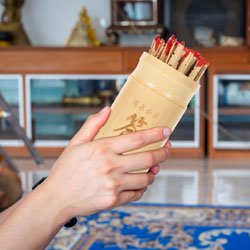
Crack your Fortune Cookie!
How to say fortune cookie in Chinese?
There are many ways to say Fortune Cookie in Chinese:
幸运饼 xìngyùn bǐng "good luck cookie"
签语饼 qiān yǔ bǐng "label-words cookie"
幸运签饼
xìngyùn qiān bǐng "good luck label cookie"
幸运签语饼
xìngyùn qiān yǔ bǐng "lucky label-words cookie"
幸运甜饼
xìngyùn tián bǐng "good luck sweet cookie"
幸福饼干 xìngfú
bǐnggān "happiness [dry] cookie"
幸运饼干
xìngyùn bǐnggān
"good luck [dry] cookie"
幸运饼
xìngyùn bǐng "good luck
cookie"
幸运籤语饼
xìngyùn qiān yǔ bǐng "good luck label-words
cookie"
占卜饼 zhānbǔ bǐng "divine cookie".
-
Click on the cookie below to crack your fortune cookie.
-

Is there a Chinese Cookie Day?
Yes there is a Chinese Cookie Day on September 13th. My Internet searches do not identify who launched the idea, but Google's search engine has decreed that the International Day of the Chinese Cookie is September 13th. Happy celebration!
What is a fortune cookie made of?
A fortune cookie is a crisp cookie made from flour, sugar, vanilla, and oil with a "fortune" wrapped inside. A "fortune" is a piece of paper with words of faux wisdom or a vague prophecy. In the United States of America and Canada (although also available in other parts of the Western world), it is usually served with Chinese food in Chinese restaurants as a dessert.
What is the meaning of the message inside the fortune cookie?
The message inside may include a Chinese phrase. What is the meaning of the message inside the fortune cookie?
Usely the translation of the Chinese message and a list of lucky numbers. Those numbers are used by some as lottery numbers.
Is the fortune cookie coming from China or Japan?
Fortune cookies in their current form were first served in California by immigrants who based the cookie on a traditional Japanese cracker. The cookies are little-known in mainland China or Taiwan.
Chinese cookie versus Omikuji, what is the difference?
As far back as the 19th century, a cookie very similar in appearance to the American Fortune cookie was made in Kyoto, Japan, and there is a Japanese temple tradition of random fortunes, called omikuji. The Japanese version of the cookie differs in several ways: they are a little bit larger; are made of darker dough; and their batter contains sesame and miso rather than vanilla and butter. They contain a fortune; however, the small slip of paper was wedged into the bend of the cookie rather than laced inside the hollow portion.
Who introduced the fortune cookie in United Sates?
Most of the people who claim to have introduced the cookie to the United States are Japanese, so the theory is that these bakers were modifying a cookie design which they were aware of from their days in Japan.
1. Makoto Hagiwara of Golden Gate Park's Japanese Tea Garden in San Francisco is reported to have been the first person in America to have served the American version of the cookie when he did so at the tea garden in 1890s or early 1900s. The fortune cookies were made by a San Francisco bakery, Benkyodo.
2. David Jung, founder of the Hong Kong Noodle Company in Los Angeles, has made a competing claim that he invented the cookie in 1918. San Francisco's mock Court of
Historical Review attempted to settle the dispute in 1983. During the proceedings, a fortune cookie was introduced as a key piece of evidence with a message reading, "S.F. Judge who rules for L.A. Not Very Smart Cookie". A federal judge of the Court of Historical Review determined that the cookie originated with Hagiwara and the court ruled in favor of San Francisco. Subsequently, the city of Los Angeles condemned the decision.
|